On this page you will read detailed information about CIBIL Score Is No Longer Mandatory for All Loan Applicants (2025 Update)
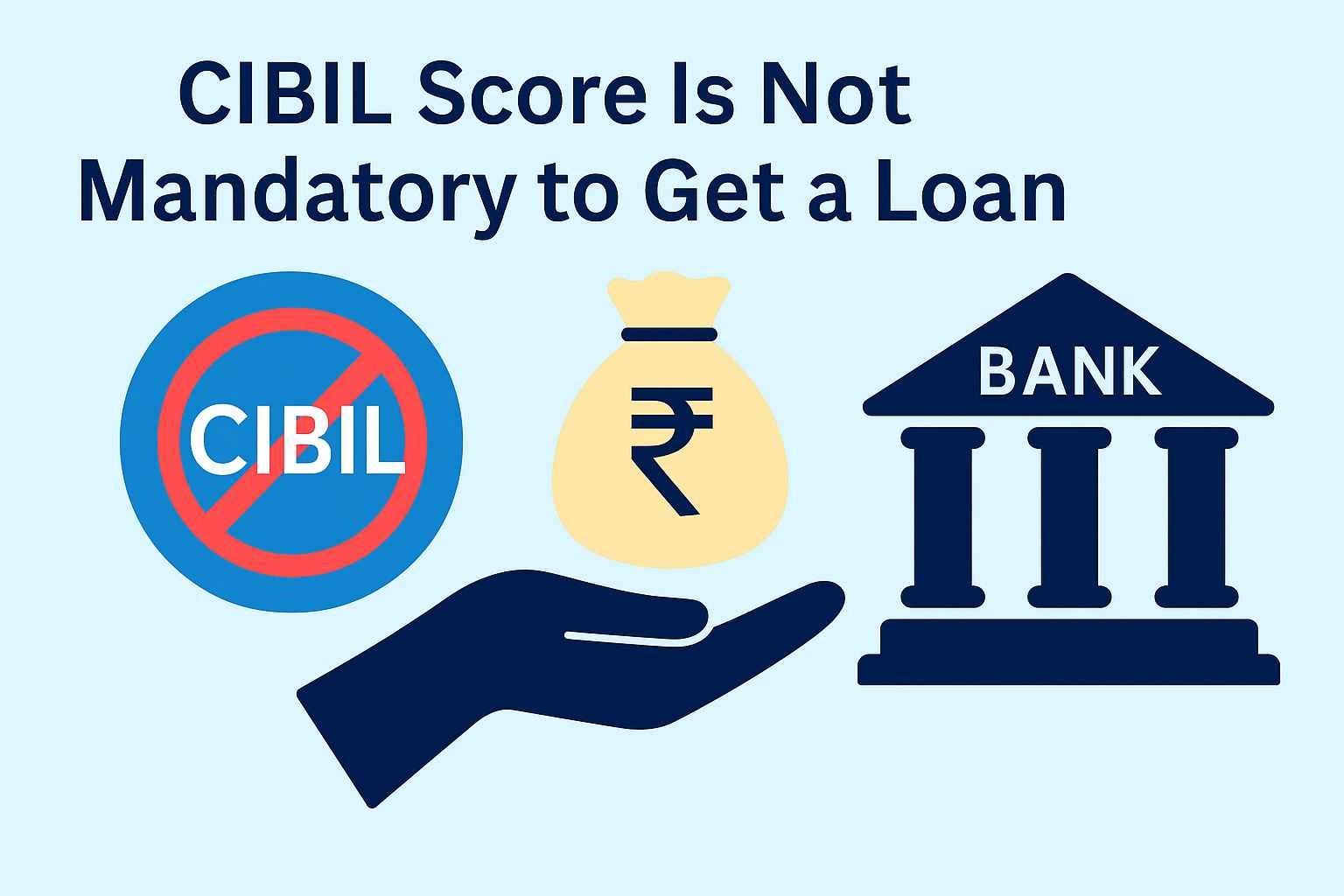
In August 2025, the Indian Ministry of Finance made a significant clarification: for first-time borrowers, banks cannot reject a loan application simply because the applicant has no CIBIL (credit bureau) score. The Finance Ministry, citing RBI guidance, also emphasized that the RBI has not prescribed a minimum credit score for loan approval.
This marks a shift in India’s credit landscape, intended to expand financial inclusion and open loan access to newcomers who lack formal credit history. That said, this doesn’t mean credit scores are obsolete—they remain a key input for many lenders—but the blanket requirement is being rolled back for new borrowers.
Let’s dig into what this means, how it works, and what both borrowers and banks must keep in mind going forward.
What Exactly the Clarification States
- No Mandatory Credit Score for First-Time Borrowers
The government instructs that banks should not reject applications from people who lack any prior credit record. - Banks Still Perform Due Diligence
The absence of a score doesn’t mean minimal scrutiny. Lenders are expected to evaluate an applicant’s income, employment stability, bank statements, and other markers of creditworthiness. - Credit Information Report Remains an Input—not the Sole Decider
The CIBIL (or other credit bureau) report may still be used when available, but its absence should not be fatal to a loan application. - No RBI-mandated Minimum Score
The RBI has not mandated a fixed cutoff for credit scores; lending decisions remain subject to the bank’s internal risk protocols and policies.
Why This Change Matters
1. Better Access for New Borrowers
Young professionals, first-time homebuyers, rural borrowers, and entrepreneurs often face challenges because they lack prior loan or credit history. This clarification removes a barrier that unfairly excluded many.
2. Inclusion & Economic Growth
By enabling broader credit access, more people can invest in homes, education, small businesses, and other ventures that stimulate growth and help bridge inequality gaps.
3. Innovation in Lending Models
Lenders will increasingly adopt alternative credit assessment tools—like transaction behavior, utility payments history, rental payments, or digital financial footprints—to evaluate credit risk.
4. Increased Competition & Customer Choice
With fewer universal barriers, more lenders—including NBFCs and fintechs—may compete to serve customers previously marginalized due to lack of credit history.
How Lenders May Adapt: Beyond the CIBIL Score
Even with the score no longer mandatory for first-time loans, lenders will guard against risk. Here are practices likely to be used:
- Income and Employment Verification: Salary slips, employer reference, business revenue statements
- Bank Statement Analysis: Inflows, regularity, balances, overdrafts
- Alternative Data: Mobile usage, utility bills, tax returns, rent payment history
- Collateral or Guarantor: For secured loans, underlying assets or third-party backing may strengthen applications
- Tiered Risk Pricing: Applicants without credit history may face slightly higher interest or stricter conditions until their credit profile is established
- Graduated Credit Limits: Lower starting amounts gradually increased with good repayment conduct
In the previous post, we had shared information about Can Police Check Your Phone Without a Warrant?, so read that post also.
Risks, Challenges & What to Watch
- Higher default risk: Without an established credit track record, predicting risk is harder, increasing NPA (non-performing asset) potential.
- Uneleavened underwriting: Banks may become conservative, denying many new-applicant cases even though the rule change intends inclusion.
- Opaque decisioning: Borrowers may still be rejected; regulators must ensure transparency in rejection reasons.
- Unequal impact across lenders: Smaller or risk-averse banks may continue stricter score reliance; large or progressive lenders are more likely to adopt new models.
- Data quality & privacy concerns: Using alternative indicators must respect privacy, accuracy, and consent norms.
What Borrowers Should Do Now
- Prepare financial documents: Salary slips, business details, tax returns, bank statements
- Show banking track record: Even small savings accounts, regular deposits help
- Use digital payment behavior: If you have good phone-banking, UPI, or utility payment history, present it
- Start with small loans or credit cards: Build your credit profile gradually
- Request reasons from lenders: If rejected, seek written justification; you may appeal or approach ombudsman
- Maintain discipline: On-time repayment is still critical for building future creditworthiness
In Summary
- As of August 2025, the Finance Ministry has clarified that CIBIL score is not mandatory for first-time borrowers in India.
- That doesn’t mean credit scores are irrelevant—but they cease to be a rigid barrier for new borrowers.
- Banks must now place greater emphasis on holistic credit evaluation—income, repayment capacity, and alternative data sources.
- Borrowers without credit history have a better chance—but must present strong supporting documents and consistent financial behavior.
Disclaimer
The information and services on this website are not intended to and shall not be used as legal advice. You should consult a Legal Professional for any legal or solicited advice. While we have good faith and our own independent research to every information listed on the website and do our best to ensure that the data provided is accurate. However, we do not guarantee the information provided is accurate and make no representation or warranty of any kind, express or implied, regarding the accuracy, adequacy, validity, reliability, availability, or completeness of any information on the Site. UNDER NO CIRCUMSTANCES SHALL WE HAVE ANY LIABILITY TO YOU FOR ANY LOSS OR DAMAGE OF ANY KIND INCURRED AS A RESULT OR RELIANCE ON ANY INFORMATION PROVIDED ON THE SITE. YOUR USE OF THE SITE AND YOUR RELIANCE ON ANY INFORMATION ON THE SITE IS SOLELY AT YOUR OWN RISK. Comments on this website are the sole responsibility of their writers so the accuracy, completeness, veracity, honesty, factuality and politeness of comments are not guaranteed.
So friends, today we talked about CIBIL Score Is No Longer Mandatory for All Loan Applicants (2025 Update), hope you liked our post.
If you liked the information about CIBIL Score Is No Longer Mandatory for All Loan Applicants (2025 Update), then definitely share this article with your friends.
Knowing about laws can make you feel super smart ! If you find value in the content you may consider joining our not for profit Legal Community ! You can ask unlimited questions on WhatsApp and get answers. You can DM or send your name & number to 8208309918 on WhatsApp