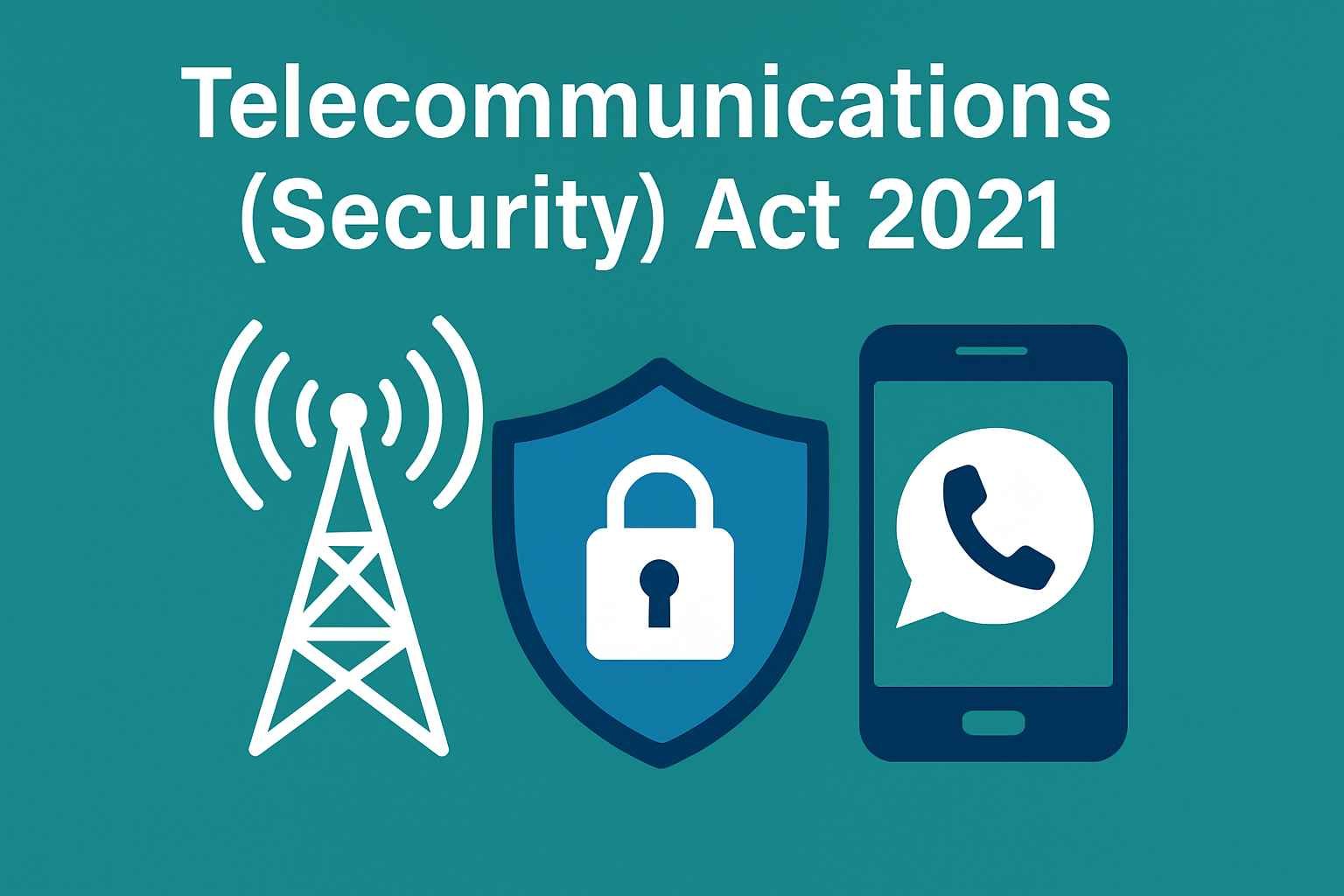
On this page you will read detailed information about Telecommunications (Security) Act 2021.
Introduction
In November 2021, the UK Parliament passed the Telecommunications (Security) Act 2021 (TSA 2021), which came into force on 1 October 2022. The Act strengthens the security obligations of providers of public electronic communications networks and services, giving the government enhanced powers to regulate security, designate high-risk vendors, and demand remedial action.
Its goal: making the UK’s telecom infrastructure resilient in the face of evolving cyber threats, supply chain vulnerabilities, and national security risks.
In 2025, as providers continue compliance, updates and consultations are underway to refine regulation and enforce tougher oversight. Let’s unpack how the Act works and its implications.
Key Provisions & Structure of the Act
Core Duties & Security Obligations
- The Act amends the Communications Act 2003 to impose new security duties on public electronic communications providers.
- Providers must identify, assess, and mitigate risks of “security compromises” — defined broadly to include unauthorized access, disruption, interference, or data alteration.
- When a security incident occurs, providers must remedy or mitigate its impact, report it, and take appropriate follow-up steps.
Tiered Approach & High-Risk Vendor Controls
- The Act uses a tiered structure (tiers based on scale, impact, or criticality) so that more significant providers face stricter obligations.
- A major feature: the government can designate “high-risk vendors”, and regulators can issue binding controls on the use of goods, services, or facilities from those vendors in networks.
- Providers may be required to exclude or limit components from such vendors, or enhance compensation measures.
Regulations & Code of Practice
- The Act is supplemented by regulations and a Code of Practice, which provide technical detail, implementation guidance, and compliance norms.
- The Electronic Communications (Security Measures) Regulations 2022 outline specific security controls for new networks and services from the date of enforcement.
Government Powers & Enforcement
- The government can issue security directions to providers to act or refrain from certain activities.
- The government and regulator (Ofcom) have powers to audit, inspect, and demand information to assess compliance.
- Noncompliance can lead to penalties or enforcement actions, especially for providers in higher tiers.
Recent Developments & Future Directions (2025)
Ongoing Consultations & Updates
In 2025, the UK government has launched consultations to update the regulated security codes, seeking to refine obligations, clarity around definitions, and the scope of vendor controls.
As technology evolves (5G, IoT, edge computing, AI in network control), kinks in the regulation surface — for example, how to treat emerging network functions or AI-driven control planes.
Compliance Maturation & Provider Challenges
Telecom providers are deep in the process of aligning with the Act’s obligations: hardening legacy systems, revalidating supply chains, upgrading audits, and operationalizing incident reporting frameworks.
Some challenges include:
- Legacy infrastructure that may not easily support modern cryptographic or isolation controls
- Complex global supply chains, where vendors are spread across jurisdictions
- Ensuring third-party vendor compliance and managing contractual cascades
- Balancing security with cost constraints
Enforcement & Security Testing Labs
New accredited security testing labs are being recognized to test compliance with telecom standards (e.g. in the UK). Monitoring, audits, and external assessments are becoming standard.
In parallel, standard bodies and cyber agencies review how providers report threats and remediation.
Why the Act Matters: Strategic Impacts
Strengthened National Resilience
Telecom networks are critical national infrastructure. Attacks on them can cascade into disruption of finance, health, transport, and security. The Act bolsters resilience at the heart of connectivity.
Supplier Risk & Geopolitics
By designating high-risk vendors and controlling vendor usage, the Act shapes the roles of foreign hardware makers, especially in 5G and beyond, pushing for diversification and secure supply chains.
Business & Operational Overhead
Telecom operators must invest in enhanced security processes, staff, audits, and incident response. Margins may tighten, especially for smaller providers.
Consumer Trust & Assurance
For consumers, the Act implies better protection against outages, network intrusion, data interception, and fraudulent traffic.
Regulatory Precedent
The TSA 2021 sets a global benchmark; other countries are watching how the UK’s telecom security regulation scales.
In the previous post, we had shared information about EU Cybersecurity Act, so read that post also.
Challenges & Critiques
- Complex implementation burden on smaller or rural operators
- Ambiguity & interpretation risk: how to define “security compromises,” what counts as high risk vendor
- Regulatory overreach: balancing security mandates with innovation and operator flexibility
- Global vendor friction: enforcing restrictions on vendors abroad may conflict with global trade
- Cost pass-through: operators may pass security compliance costs to consumers
What Telecom Providers Should Do (Roadmap for 2025+)
- Perform risk inventories of all network elements — vendors, software, hardware, control systems
- Review vendor contracts to include security obligations, audits, removal rights
- Implement continuous monitoring, segmentation, and zero-trust principles
- Build incident response and reporting protocols aligned with legal duty
- Plan for future expansions (5G, edge, IoT) under compliance constraints
- Engage with the regulatory process — participate in consultations, submit feedback
- Budget for compliance — security upgrades are not optional under the law
Conclusion
The Telecommunications (Security) Act 2021 is a landmark law in the UK’s telecom regulation. By embedding rigorous security duties, vendor oversight, and government powers, it aims to future-proof the country’s communication networks. As 2025 unfolds, the focus shifts from legislative promise to real compliance, enforcement, and evolution alongside tech progress.
Disclaimer
The information and services on this website are not intended to and shall not be used as legal advice. You should consult a Legal Professional for any legal or solicited advice. While we have good faith and our own independent research to every information listed on the website and do our best to ensure that the data provided is accurate. However, we do not guarantee the information provided is accurate and make no representation or warranty of any kind, express or implied, regarding the accuracy, adequacy, validity, reliability, availability, or completeness of any information on the Site. UNDER NO CIRCUMSTANCES SHALL WE HAVE ANY LIABILITY TO YOU FOR ANY LOSS OR DAMAGE OF ANY KIND INCURRED AS A RESULT OR RELIANCE ON ANY INFORMATION PROVIDED ON THE SITE. YOUR USE OF THE SITE AND YOUR RELIANCE ON ANY INFORMATION ON THE SITE IS SOLELY AT YOUR OWN RISK. Comments on this website are the sole responsibility of their writers so the accuracy, completeness, veracity, honesty, factuality and politeness of comments are not guaranteed.
So friends, today we talked about Telecommunications (Security) Act 2021, hope you liked our post.
If you liked the information about Telecommunications (Security) Act 2021, then definitely share this article with your friends.