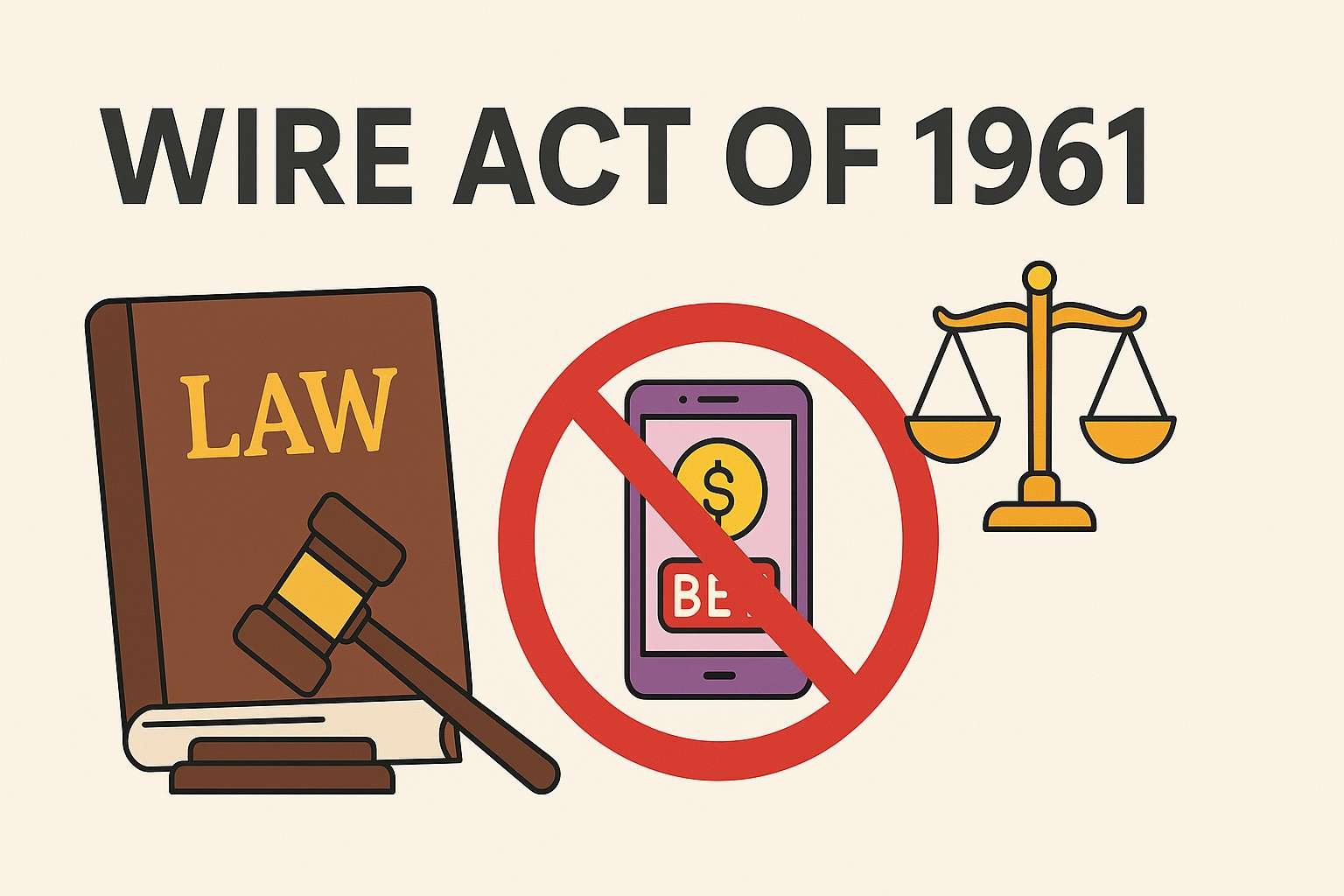
On this page you will read detailed information about Wire Act of 1961.
What Is the Wire Act of 1961?
The Wire Act of 1961, formally known as 18 U.S.C. § 1084, is a U.S. federal statute aimed at regulating telecommunications in respect to gambling. In essence, it prohibits using “wire communication facilities” (telephone, telegraph, or digital communications) to transmit bets or wagering information across state or foreign lines in connection to sporting events or contests.
It was passed as part of a broader legislative push to curtail organized crime’s influence, especially in gambling operations that used phone lines across states to coordinate bets.
Over time, the Wire Act’s application to online gambling, non‐sports wagering, and intrastate transmissions has been subject to legal interpretations, shifting DOJ opinions, and court rulings. Below is its origin, key provisions, evolving interpretations, controversies, and current status.
Historical Background & Purpose
- In the 1950s–60s, organized crime syndicates leveraged telecommunication networks to place bets across state lines, particularly for horse races and sporting events. The federal government sought mechanisms to disrupt this infrastructure.
- The Wire Act was introduced in Congress under the “omnibus crime bill” and signed by President John F. Kennedy on September 13, 1961.
- The intent was to target illegal interstate gambling operations, not to criminalize all forms of wagering per se, but specifically the use of communication wires (telephone, telegraph) in interstate or foreign betting schemes.
Key Provisions of the Wire Act
1. Prohibition on Transmission of Bets or Wagering Information
The statute states:
“Whoever being engaged in the business of betting or wagering knowingly uses a wire communication facility for the transmission in interstate or foreign commerce of bets or wagers or information assisting in placing bets or wagers on any sporting event or contest…”
— 18 U.S.C. § 1084(a)
This means that if a person or entity is in the business of gambling, they cannot use wire communications (telephonic or digital) to transmit bets or related information across state or national lines.
2. Safe Harbor / Exceptions
The Act includes a carve-out:
Transmission of information for news reporting of sporting events, or transmission of information assisting placing bets if both ends are in jurisdictions where gambling is legal.
— 18 U.S.C. § 1084(b)
This safe harbor aims to allow legitimate reporting and to permit lines of communication when betting is legal in both the source and destination jurisdictions.
3. Penalties & Enforcement
Violators can face fines, imprisonment (up to 2 years for first offense), or both.
The statute also gives common carriers (i.e. telecommunications providers) an obligation: once notified by law enforcement that their facilities are being used for prohibited wagering transmissions, carriers must refuse or discontinue that facility for the subscriber, after notice, without liability.
4. Non‐Exclusivity & Other Laws
The Wire Act does not override or immunize actions from local or state gambling laws. That is, even if someone violates a state law, the Wire Act doesn’t grant immunity.
The statute also does not affect or prevent prosecutions under state gambling laws.
Evolving Interpretations & Legal Debate
Application to Online Gambling & Digital Platforms
The original statute was drafted in an era of telephone-based communication. It did not anticipate the internet, online poker, e-casinos, or remote gambling. Courts and DOJ have wrestled with whether the Act should apply to internet betting, casino games, or lotteries besides sports betting.
- In 2011, the Office of Legal Counsel (OLC) opined that the Wire Act’s prohibition should be read to apply only to sports wagering, not to other forms of online gambling such as poker or casino games.
- However, in 2018–2019, the DOJ reversed that view, issuing a new opinion asserting that the Wire Act applies more broadly to all types of interstate gambling, not just sports betting.
- This reversal triggered confusion, lawsuits, and legal challenges. For example, some parties sought injunctive relief or declaratory judgments on whether the Act could be construed to cover non-sports gambling.
Intrastate Transmissions & Commerce Clause
Another contentious topic: does the Wire Act apply to intrastate (within the same state) use of communications for betting? The statutory language speaks of “interstate or foreign commerce,” which suggests not—but courts sometimes interpret the reach of federal commerce power quite broadly.
Some scholars argue that even intrastate gambling transactions that use telecommunications can implicate interstate commerce if they cross state lines in infrastructure or use networks spanning state boundaries.
Yet other legal interpretations hold that the Wire Act should not extend to pure intrastate betting, and that federal reach should be limited to interstate transmissions.
Conflicting Court Rulings & Uncertainty
The legal landscape is inconsistent:
- The Fifth Circuit (in one case) upheld that the Wire Act’s prohibition is limited to sports betting, not all gambling.
- Some lower courts have taken broader approaches.
- Injunctions and litigation remain ongoing in many jurisdictions, leaving operators and regulators uneasy about which standard applies.
Thus, the Wire Act remains a partially unsettled statute, especially in the digital age.
In the previous post, we had shared information about FERPA Compliance: Protecting Student Information the Right Way, so read that post also.
Why the Wire Act Still Matters Today
- Online sports betting growth
With the rise of mobile apps and transportable networks, the Wire Act is often invoked in debates about the legality of interstate sports betting platforms. - Regulatory leverage
Federal law can complement or override state gambling regimes by providing authority over interstate communications. - Enforcement tool
Law enforcement agencies may use it to target cross-border or multistate gambling operations that avoid state licensing or oversight. - Legal uncertainty for operators
Gambling and online gaming companies often structure operations (servers, payment gateways, geofencing) to avoid exposure under Wire Act liability.
Critiques & Challenges
- Statutory ambiguity: The language is broad, and its interpretation over decades has been inconsistent.
- Technological mismatch: The Act was drafted in 1961—long before the internet and modern digital communications.
- Overreach concerns: Some argue that applying it to non-sports gambling or intrastate betting may go beyond what Congress intended.
- Impact on state autonomy: Critics warn that federal invocation via the Wire Act could impinge upon states’ ability to regulate their own gaming laws.
- Judicial pushback: Some judges and litigants challenge the DOJ’s reinterpretation, contending that the statute should be narrowly construed.
Recent Developments & Current Status (2023–2025)
- Legal challenges continue in various U.S. jurisdictions over the 2018 DOJ re-interpretation of the Wire Act’s scope beyond sports gambling.
- Some states have legalized intrastate online gambling (e.g. state lotteries, online poker), arguing that these do not fall under the Wire Act because they don’t cross state lines.
- The DOJ’s current interpretation is that wire transmissions of bets—even in non-sports contexts—could be subject to prosecution if interstate.
- However, many operators rely on geographic filtering, server localization, and compliance structures to avoid triggering Wire Act liability.
Given this complexity, many stakeholders monitor litigation, legislative proposals, and DOJ opinions closely.
Practical Implications & Guidance
For gambling operators, financial institutions, and regulators:
- Assess communications footprint: Ensure that systems do not transmit betting data across state or national lines if that would risk invoking the Wire Act.
- Structure operations carefully: Consider localizing servers, segregating data, employing geofencing and so on.
- Legal clarity: Seek declaratory judgments or safe harbor mechanisms to reduce exposure.
- Monitor evolving law: The Wire Act, related statutes, and court rulings evolve—stay updated on DOJ, OLC opinions, and litigation.
- Work with counsel: Given the complexity and uncertainty, expert legal advice is essential.
Summary (Key Takeaways)
- The Wire Act of 1961 is a U.S. federal law prohibiting interstate transmission of bets, wagers, or related betting information via wire communication.
- Its original focus was on sports wagering, though later interpretations (especially 2018 DOJ) suggest broader application to other forms of gambling.
- The Act includes a safe harbor: permissible transmission of information in both jurisdictions where gambling is legal.
- A major legal question is whether the Act applies to purely intrastate communications. Courts and scholars differ.
- In the era of online gambling and cross-state digital communications, the Wire Act continues to be relevant—but complicated by evolving technology and legal interpretation.
Disclaimer
The information and services on this website are not intended to and shall not be used as legal advice. You should consult a Legal Professional for any legal or solicited advice. While we have good faith and our own independent research to every information listed on the website and do our best to ensure that the data provided is accurate. However, we do not guarantee the information provided is accurate and make no representation or warranty of any kind, express or implied, regarding the accuracy, adequacy, validity, reliability, availability, or completeness of any information on the Site. UNDER NO CIRCUMSTANCES SHALL WE HAVE ANY LIABILITY TO YOU FOR ANY LOSS OR DAMAGE OF ANY KIND INCURRED AS A RESULT OR RELIANCE ON ANY INFORMATION PROVIDED ON THE SITE. YOUR USE OF THE SITE AND YOUR RELIANCE ON ANY INFORMATION ON THE SITE IS SOLELY AT YOUR OWN RISK. Comments on this website are the sole responsibility of their writers so the accuracy, completeness, veracity, honesty, factuality and politeness of comments are not guaranteed.
So friends, today we talked about Wire Act of 1961, hope you liked our post.
If you liked the information about Wire Act of 1961, then definitely share this article with your friends.